
Safety information
Safety information
Toxicity: Mild. Generally low-toxicity; silicic-acid/tannin content -> caution with very prolonged use.
Contraindications: Acute kidney inflammation/renal disease where diuresis is inappropriate; pregnancy/lactation (insufficient data — caution); thrombophlebitis (folk caution re: coagulation).
Interactions: Theoretical additive with diuretics; tannin-absorption caution.
Pregnancy & breastfeeding: Pregnancy/lactation: insufficient data — caution.
Evidence level
Supported by laboratory or animal studies; not yet confirmed in humans.
Preparations
decoction · flowering herb
Part used: flowering herb
infusion (tea) · flowering herb
Part used: flowering herb
Traditional use: mild diuretic for urinary-tract complaints, to pass urinary 'sand/stones', cough, astringent for diarrhoea, 'to strengthen'
Proposed mechanism: flavonoids (avicularin, quercetin glycosides), silicic acid, tannins
Associated conditions
Edibility
Edible parts: Young plant is edible cooked in some traditions but wiry/astringent — used as a tea herb, not a staple food.
Toxic lookalike warning
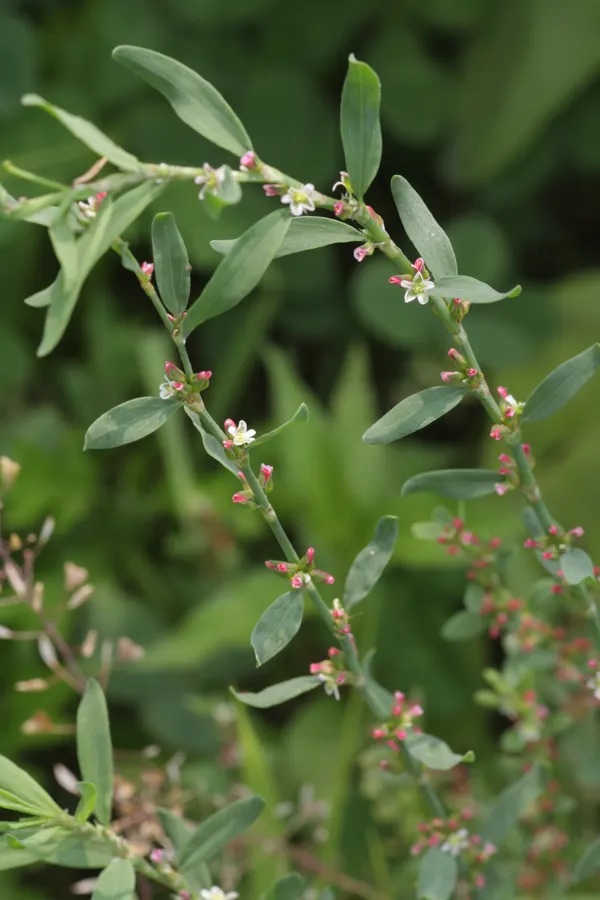
Small prostrate mat-forming plant with tiny leaves sheathed by membranous ochreae — verify Polygonum aviculare; avoid confusion with unrelated prostrate weeds.
Nutritional notes
Source of silicic acid, flavonoids; minor.
Healing traditions
Related plants
- Daruharidra (tree turmeric / Indian barberry)Berberis aristataClinical
- Musta (nutgrass)Cyperus rotundusClinical
- Khadira (black catechu / cutch tree)Acacia catechuClinical
- Kalgan / TormentilPotentilla erectaClinical
- Sangre de grado / Dragon's bloodCroton lechleriClinical
- Amur cork tree bark / huang bai (黄柏)Phellodendron amurenseClinical
Sources (1)
- Olas et al. 2024, Pharmaceuticals (PMC11054606)
Sourcing & resources
Affiliate links — we may earn a small commission at no extra cost to you.