
Safety information
Safety information
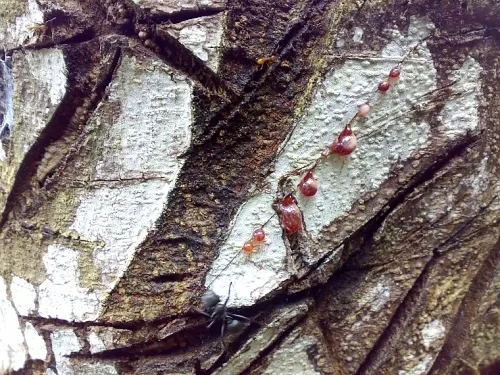
Toxicity: Generally well tolerated; topical use may cause transient burning. Latex contains taspine (alkaloid) and proanthocyanidins; raw exudate is concentrated — internal use should be supervised. One report noted increased leukemic-cell viability in vitro (caution flag, Styczynski 2006).
Contraindications: Avoid with dacomitinib (animal data); pregnancy/lactation — insufficient data, avoid internal use.
Interactions: Dacomitinib. Crofelemer minimally absorbed, limiting systemic interactions, but crude latex is chemically complex — caution.
Pregnancy & breastfeeding: Pregnancy/lactation: insufficient data — avoid internal use.
Evidence level
Supported by clinical trials in humans.
Preparations
taken internally diluted · latex/sap
Part used: latex/sap
resin extracts; pharmaceutical crofelemer tablet · latex/sap
Part used: latex/sap
latex applied topically to wounds · latex/sap
Part used: latex/sap
Traditional use: stop bleeding and heal wounds/insect bites; internally for diarrhea, ulcers, inflammation
Proposed mechanism: wound-healing principle taspine; antisecretory mechanism; purified proanthocyanidin crofelemer
Dosage note (descriptive only): internal use should be supervised
Associated conditions
Nutritional notes
Not relevant.
Healing traditions
Related plants
- Daruharidra (tree turmeric / Indian barberry)Berberis aristataClinical
- Musta (nutgrass)Cyperus rotundusClinical
- Khadira (black catechu / cutch tree)Acacia catechuClinical
- Kalgan / TormentilPotentilla erectaClinical
- Amur cork tree bark / huang bai (黄柏)Phellodendron amurenseClinical
- BaelAegle marmelosClinical
Sources (1)
- Croton lechleri — MSKCC About Herbs, 2019
Sourcing & resources
Affiliate links — we may earn a small commission at no extra cost to you.