
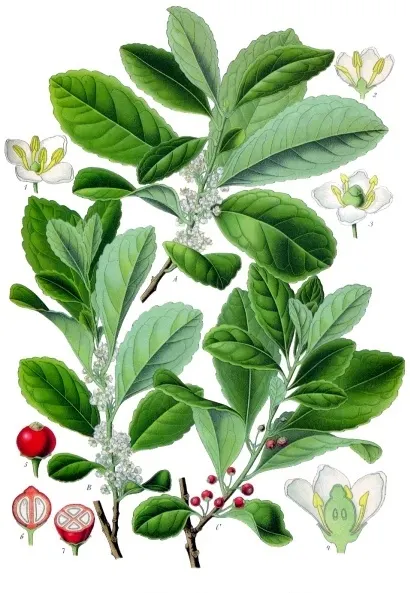
Yerba Mate
Ilex paraguariensis
Edible plantPhoto credit: Franz Eugen Köhler, Köhler's Medizinal-Pflanzen
Safety information
Safety information
Toxicity: Contains caffeine (~0.7-2%) and theobromine — overconsumption causes insomnia, tachycardia, anxiety, GI upset. IARC (1991) classified 'hot mate' Group 2A; the 2016 re-evaluation attributes the esophageal-cancer risk primarily to drinking at very hot temperatures (>65 C). PAHs from smoke-drying may add contaminant risk.
Contraindications: Caffeine sensitivity, arrhythmia, uncontrolled hypertension, anxiety disorders, pregnancy/breastfeeding; avoid scalding-hot to reduce esophageal risk.
Interactions: Additive stimulation with other caffeine sources; potential MAO-inhibitor interaction; affects CYP1A2-metabolized drugs (caffeine); caution with stimulants, ephedrine, theophylline.
Pregnancy & breastfeeding: Caution in pregnancy/breastfeeding.
Evidence level
Supported by clinical trials in humans.
Preparations
tea bags; extracts · dried leaves
Part used: dried leaves
hot or cold water infusion drunk through a bombilla · dried leaves
Part used: dried leaves
Traditional use: stimulant and tonic for fatigue, mental/physical performance; appetite/weight control; diuretic; digestive aid
Proposed mechanism: polyphenols (chlorogenic acid), flavonoids, xanthines (caffeine, theobromine), saponins — antioxidant and metabolic
Dosage note (descriptive only): avoid scalding-hot (>65 C) to reduce esophageal risk
Associated conditions
Edibility
Edible parts: Leaves used only as a steeped beverage (not eaten whole).
Toxic lookalike warning
Avoid wild-foraged unidentified holly — many Ilex species (I. aquifolium) have toxic emetic berries; never substitute ornamental holly.
Nutritional notes
Polyphenols (chlorogenic acid), flavonoids (quercetin, rutin, kaempferol), saponins, xanthines (caffeine, theobromine), minerals (P, Fe, Ca), vitamins C, B1, B2.
Healing traditions
Related plants
Sources (2)
- Mate Drinking and Esophageal SCC (pooled case-control), Cancer Epidemiol Biomarkers Prev, 2014
- Yerba Mate antioxidant compounds, PMC8868397, 2022
Sourcing & resources
Affiliate links — we may earn a small commission at no extra cost to you.