
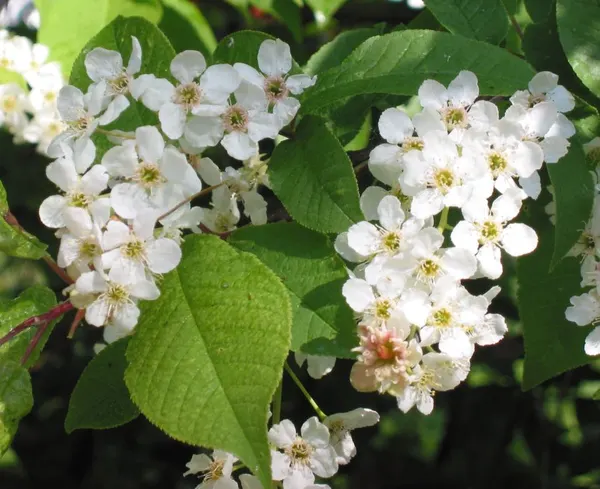
Safety information
Safety information
Toxicity: Serious in the seed/leaf/bark — cyanogenic. Seeds (kernels), leaves, bark and flowers contain cyanogenic glycosides (amygdalin/prunasin) that release hydrogen cyanide; the fleshy ripe fruit pulp is the edible part. Bitter-almond smell signals cyanogen content.
Contraindications: Do not eat the kernels; avoid bark/leaf/seed self-preparations; caution in children (accidental kernel ingestion); pregnancy/lactation (avoid medicinal bark/seed forms).
Interactions: None well-characterised for the fruit pulp.
Pregnancy & breastfeeding: Avoid medicinal bark/seed forms in pregnancy/lactation.
Evidence level
Documented in systematic traditional medicine literature.
Preparations
infusion/decoction of dried fruit · fruit
Part used: fruit
Traditional use: astringent anti-diarrhoeal tea/decoction(Folk and historical sources have not been validated by clinical research.)
Proposed mechanism: fruit pulp tannin- and anthocyanin-rich (astringent)
Dosage note (descriptive only): NOT the seed/kernel
dried-fruit flour (Siberian) · fruit
Part used: fruit
Traditional use: fragrant flour for baking (cheryomukhovaya muka)(Folk and historical sources have not been validated by clinical research.)
decoction of bark (folk) · bark
Part used: bark
Traditional use: wash and folk cold remedy(Folk and historical sources have not been validated by clinical research.)
Associated conditions
Edibility
Edible parts: Ripe fruit pulp only (fresh in small amounts, or dried/milled; spit out stones).
Toxic lookalike warning
The seed/kernel, leaves and bark are cyanogenic — never substitute them for the pulp; do not confuse with other dark wild cherries without ID.
Nutritional notes
Fruit provides anthocyanins, tannins, vitamin C; Siberian fruit flour is a traditional functional baking ingredient.
Healing traditions
Related plants
- Daruharidra (tree turmeric / Indian barberry)Berberis aristataClinical
- Musta (nutgrass)Cyperus rotundusClinical
- Khadira (black catechu / cutch tree)Acacia catechuClinical
- Kalgan / TormentilPotentilla erectaClinical
- Sangre de grado / Dragon's bloodCroton lechleriClinical
- Amur cork tree bark / huang bai (黄柏)Phellodendron amurenseClinical
Sources (1)
- Gonzalez Carretero et al. 2026, PLoS One (PMC12959656)
Sourcing & resources
Affiliate links — we may earn a small commission at no extra cost to you.